
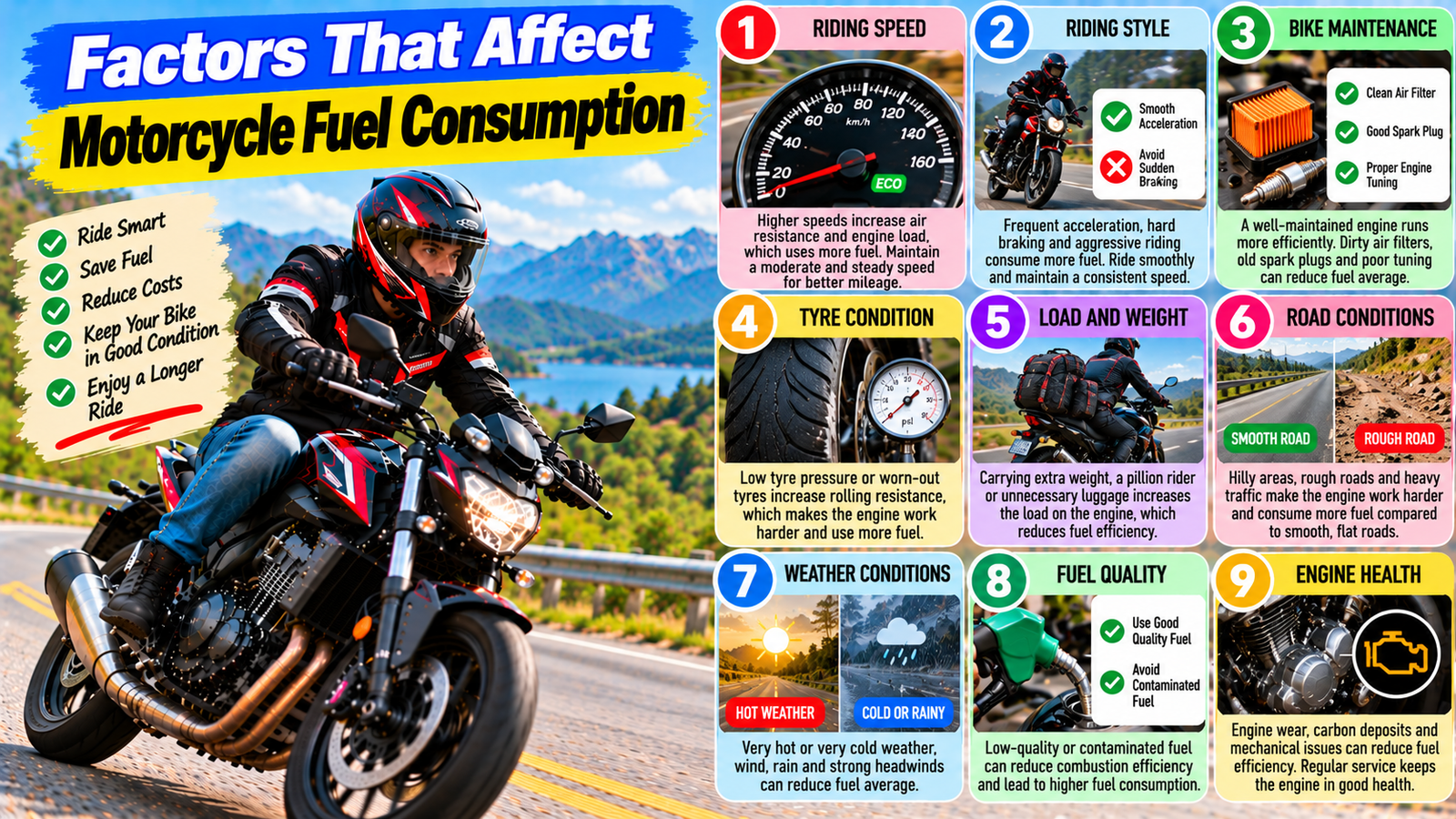
Motorcycle fuel consumption can vary significantly from one rider to another, even when they own the same model. I think this sometimes surprises new riders because they expect the motorcycle to deliver exactly the fuel average mentioned by the manufacturer.
In reality, motorcycle fuel consumption depends on many different factors. Riding style, traffic, road conditions, motorcycle maintenance, tire pressure, engine condition, load, weather, and even the type of journey can influence how much fuel is used.
Understanding these factors can help riders improve fuel economy and identify problems when fuel consumption suddenly becomes worse.
Riding Style
One of the biggest factors affecting motorcycle fuel consumption is riding style.
Aggressive acceleration usually requires more fuel than smooth acceleration. Frequently changing speed can also increase fuel use.
I believe a smooth riding style is one of the easiest ways to improve fuel economy.
This means accelerating progressively, maintaining a suitable speed, and avoiding unnecessary bursts of throttle.
You should always ride according to traffic and road conditions rather than focusing only on fuel economy.
Riding Speed
Speed can have a major effect on fuel consumption.
As speed increases, the motorcycle has to overcome greater air resistance. This can require more engine power and therefore more fuel.
Riding at a moderate and consistent speed can often be more economical than continuously riding at very high speeds.
However, riders should always follow local speed limits and choose a safe speed for the road.
Traffic Conditions
City traffic can have a significant effect on motorcycle fuel consumption.
Constant stopping, starting, accelerating, and braking can increase fuel use.
Heavy traffic also means the motorcycle may spend more time running without covering much distance.
If you commute through congested roads every day, your fuel average may naturally be lower than someone who rides mostly on open roads.
Tire Pressure
Tire pressure is another important factor.
Underinflated tires can increase rolling resistance, which may require more energy from the engine.
I recommend checking tire pressure regularly and following the pressure recommended by the motorcycle manufacturer.
Tire condition also matters. Worn or damaged tires can affect handling and safety, so they should not be ignored simply because you are trying to improve fuel economy.
Motorcycle Maintenance
Regular maintenance can have a direct impact on how efficiently a motorcycle operates.
A neglected motorcycle may develop problems that increase fuel consumption.
The air filter, spark plug, engine oil, chain, fuel system, brakes, and other components should be maintained according to the manufacturer’s recommendations.
If the motorcycle is not operating properly, fuel economy may suffer.
Engine Condition
The condition of the engine is another major factor.
An engine that is running correctly should operate within its designed parameters.
If the engine develops problems with combustion, fuel delivery, air intake, ignition, or other systems, fuel consumption may change.
A sudden and unexplained increase in fuel consumption should not simply be accepted as normal.
It is worth checking the motorcycle to determine whether a mechanical issue is responsible.
Motorcycle Weight
The total weight carried by the motorcycle can affect fuel consumption.
A heavier motorcycle generally requires more energy to accelerate.
If you regularly carry a passenger, heavy luggage, or unnecessary equipment, you may notice some difference in fuel use.
This does not mean you should remove essential safety equipment.
Instead, avoid carrying unnecessary weight whenever practical.
Aerodynamics
Aerodynamics can also influence fuel consumption.
A rider’s position, luggage, accessories, windshield, and other modifications can affect how easily the motorcycle moves through the air.
At higher speeds, aerodynamic effects become more important.
Large luggage or accessories that create additional wind resistance can increase fuel use.
Road Conditions
The road itself can affect motorcycle fuel consumption.
Smooth roads may allow more consistent riding, while rough roads, steep hills, loose surfaces, and frequent stops can require more energy.
Riding uphill generally requires additional engine effort.
Downhill sections may reduce fuel demand, but riders should never coast in an unsafe manner simply to save fuel.
Weather Conditions
Weather is another factor many riders overlook.
Strong winds can increase aerodynamic resistance and require more engine power.
Cold temperatures can also influence how an engine operates, particularly during startup and warm up.
Rain can change road conditions and may cause riders to adjust speed and riding style.
Extreme heat can also affect the motorcycle and rider.
Fuel Quality
Fuel quality and the fuel specification recommended for your motorcycle can matter.
Always use fuel that meets the motorcycle manufacturer’s requirements.
If you notice poor engine performance or a sudden change in fuel consumption after refueling, consider whether the fuel quality could be a factor.
If problems continue, have the motorcycle checked rather than assuming fuel is always responsible.
Engine Oil
The correct engine oil is important for proper engine operation.
Using an unsuitable oil may affect how the engine operates.
I recommend checking your owner’s manual and using the oil grade and specification recommended by the manufacturer.
Regular oil changes are also an important part of motorcycle maintenance.
Air Filter Condition
The engine needs the correct balance of air and fuel for efficient operation.
A dirty or restricted air filter can affect airflow.
Depending on the motorcycle design and engine management system, this may contribute to changes in performance and fuel consumption.
The air filter should be inspected and replaced or cleaned according to the manufacturer’s instructions.
Spark Plug Condition
Spark plugs are responsible for creating the spark needed for combustion in many gasoline motorcycle engines.
A worn, fouled, or damaged spark plug can affect engine performance.
If your motorcycle is running poorly or fuel consumption has changed significantly, the spark plug may be one of the components worth checking.
Follow the manufacturer’s service recommendations.
Chain Condition
The motorcycle chain transfers power from the engine to the rear wheel.
A poorly maintained chain can affect power transmission and may contribute to inefficient operation.
Keep the chain clean, lubricated, and adjusted according to the manufacturer’s specifications.
If the chain or sprockets are worn, they may need professional inspection or replacement.
Brake Drag
A brake that is not releasing properly can create unnecessary resistance.
This means the engine may have to work harder to move the motorcycle.
If you notice that a wheel feels unusually hot, the motorcycle does not roll normally, or braking behavior has changed, have the brakes inspected.
Do not continue riding a motorcycle with a suspected brake problem.
Passenger and Luggage
Carrying a passenger changes the total weight and can affect fuel consumption.
Additional luggage can have a similar effect.
A passenger can also change the way the motorcycle accelerates, climbs hills, and responds to traffic.
This is normal and does not necessarily indicate a problem with the motorcycle.
Motorcycle Type and Engine Size
Different motorcycles are designed for different purposes.
Engine size, weight, gearing, aerodynamics, and overall design can all influence fuel consumption.
A lightweight commuter motorcycle may use considerably less fuel than a larger touring or performance motorcycle.
This is why fuel economy figures should be considered in the context of the motorcycle itself.
Fuel Consumption Tracking
I recommend tracking your own motorcycle’s fuel consumption instead of relying only on advertised figures.
Record your mileage and fuel amount over several refueling cycles.
This gives you a better understanding of how the motorcycle performs under your actual riding conditions.
If consumption changes suddenly, investigate the reason.
Final Thoughts
Many factors affect motorcycle fuel consumption, and there is rarely one single explanation for poor fuel average.
Riding style, speed, traffic, tire pressure, maintenance, engine condition, motorcycle weight, weather, road conditions, fuel quality, and accessories can all play a role.
I believe the best approach is to look at the motorcycle as a complete system rather than blaming one component immediately.
Keep the motorcycle maintained, ride smoothly, monitor tire pressure, avoid unnecessary aggressive riding, and track your fuel consumption.
If fuel economy suddenly becomes much worse without an obvious reason, have the motorcycle inspected.
Understanding the factors that affect motorcycle fuel consumption can help you save money, maintain your motorcycle properly, and enjoy more efficient everyday riding.

