Learning to ride a motorcycle can be an exciting experience, but I believe beginners should focus on building good habits rather than simply trying to ride faster. A motorcycle gives me a sense of freedom and control, but it also requires attention, balance, coordination, and responsible decision making.
When I first think about beginner motorcycle riding tips, I consider the basics most important. Learning how to control the motorcycle, use the brakes correctly, change gears smoothly, understand traffic, and wear appropriate safety equipment can make a major difference.
Start With the Right Motorcycle
Choosing a suitable motorcycle is one of the first decisions a beginner should make.
A motorcycle that is too heavy, too powerful, or difficult to control can make learning unnecessarily stressful. I prefer the idea of starting with a motorcycle that allows the rider to comfortably reach the controls and place both feet securely when stopped.
A beginner should become familiar with the motorcycle’s weight, throttle response, clutch, brakes, gear pattern, and controls before riding in busy traffic.
Learn the Basic Controls
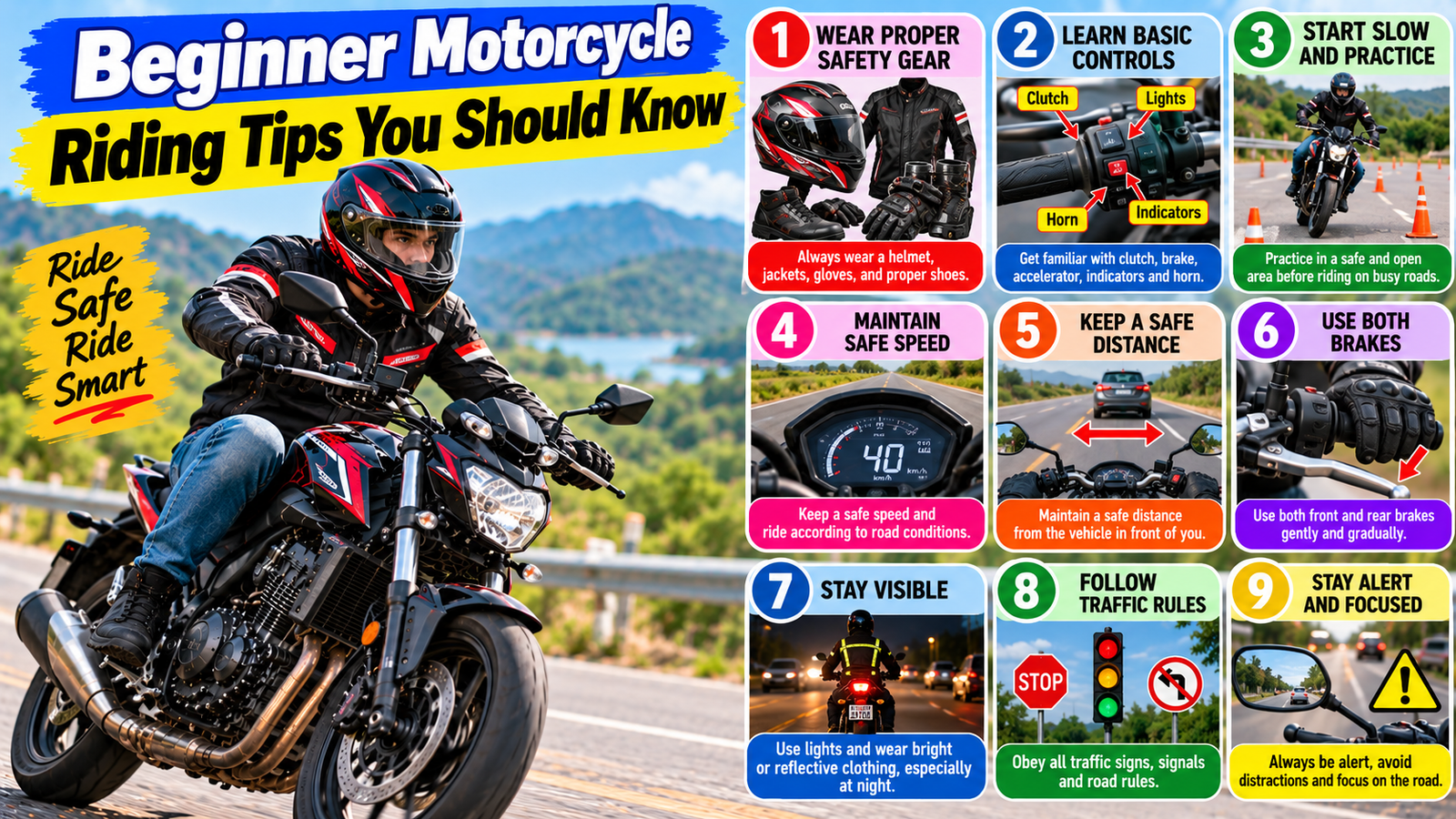
Before riding on public roads, I recommend learning where every important control is located.
The throttle controls engine power. The clutch allows smooth engagement between the engine and transmission. The front and rear brakes help slow and stop the motorcycle. The gear selector allows the rider to choose the appropriate gear.
Turn signals, horn, headlights, mirrors, and the engine stop switch are also important.
I believe beginners should practice using these controls until they can operate them without constantly looking down.
Practice in a Safe Area
A quiet and controlled location is useful when learning basic motorcycle skills.
Before dealing with traffic, I would practice starting, stopping, turning, shifting gears, using both brakes, and maintaining a straight line.
The goal is not speed. The goal is developing smooth control.
A beginner who can confidently control the motorcycle at low speeds will usually feel much more comfortable when moving into more challenging riding conditions.
Learn Smooth Throttle Control
The motorcycle throttle should be operated gradually.
Abrupt throttle movements can make the motorcycle accelerate unexpectedly. This can be especially difficult for beginners who are still learning how sensitive the throttle can be.
I prefer smooth and controlled throttle movements. When accelerating, I gradually increase the throttle rather than twisting it aggressively.
Smooth throttle control becomes especially important when turning, riding over uneven roads, or moving through traffic.
Understand Clutch Control
Clutch control is one of the most important beginner motorcycle riding skills.
A motorcycle can move smoothly when the clutch is released gradually while applying appropriate throttle.
If the clutch is released too quickly, the motorcycle may stall or move suddenly.
I recommend practicing the friction zone in a safe area. Learning where the clutch begins to engage makes slow speed riding much easier.
Use the Brakes Correctly
Braking is one of the most important motorcycle safety skills.
The front brake provides significant stopping power, while the rear brake also contributes to stability and control.
I recommend practicing smooth braking rather than grabbing the controls suddenly.
The amount of braking required depends on speed, road surface, traffic, and weather.
Beginners should practice emergency braking in a controlled environment with proper instruction.
Look Where You Want to Go
One habit I consider extremely important is looking ahead.
When turning, riders should generally look toward the direction they want the motorcycle to travel rather than staring directly at an obstacle.
Keeping the eyes focused farther ahead provides more time to recognize hazards and plan a response.
Good observation is one of the most valuable motorcycle riding skills.
Keep a Safe Following Distance
Motorcycles need enough space to react to traffic.
I recommend maintaining a safe following distance from the vehicle ahead. This gives the rider more time to brake if traffic suddenly slows.
Following too closely is especially risky because motorcycles are smaller than cars and may be less visible to other drivers.
More space also gives the rider a better view of road conditions.
Learn to Use Mirrors
Mirrors should be checked regularly, but I would not rely on them alone.
A quick mirror check can help me understand what is happening behind the motorcycle. Before changing direction or position, I also need to remain aware of blind spots and surrounding traffic.
Developing a regular observation routine makes riding more predictable.
Be Careful Around Cars
One of the most important beginner motorcycle tips is to assume that other drivers may not see you.
Motorcycles are smaller than cars and can easily disappear into blind spots.
I recommend positioning the motorcycle where it is visible and avoiding unnecessary time beside another vehicle.
Using headlights, signals, and appropriate road positioning can help other road users recognize the motorcycle.
Ride According to Conditions
A beginner should never assume that the same riding technique works perfectly in every situation.
Rain, gravel, potholes, strong wind, darkness, and poor road surfaces can all affect motorcycle control.
I prefer to reduce speed and increase caution when conditions become difficult.
The safest speed is one that allows the rider to maintain control and respond to unexpected hazards.
Wear Proper Safety Gear
Motorcycle safety gear is extremely important.
A suitable helmet is essential. Depending on the riding environment, protective clothing, gloves, boots, and other protective equipment can also provide valuable protection.
I believe beginners should develop the habit of wearing appropriate gear from the beginning rather than treating it as optional.
Avoid Showing Off
A common mistake among new riders is trying to prove their skills through speed or aggressive riding.
I think confidence should come from control rather than speed.
A rider who understands the motorcycle, observes traffic, and knows personal limits is developing much better skills than someone simply riding fast.
Continue Learning
Becoming comfortable on a motorcycle takes time.
Even after learning the basics, there are many skills to develop, including cornering, emergency braking, riding in rain, highway riding, and handling different road surfaces.
Professional motorcycle training can be extremely valuable because an instructor can identify habits that a beginner may not notice.
Final Thoughts
Beginner motorcycle riding is about building confidence through practice and responsible habits.
From my perspective, the most important skills are smooth throttle control, clutch coordination, proper braking, good observation, safe following distance, and understanding traffic.
I would never recommend rushing the learning process. Taking time to practice in safe environments and gradually increasing riding difficulty can make the experience much more enjoyable.
A good beginner rider does not need to know everything immediately. The goal is to keep learning, respect the motorcycle, understand the road, and make safety a priority every time the engine starts.