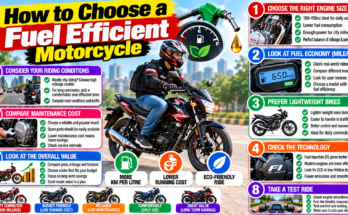
Fuel efficiency is one of the main things I would consider when choosing a motorcycle for regular use. Fuel prices can have a noticeable effect on the total cost of motorcycle ownership, especially for people who commute every day.
A fuel efficient motorcycle does not simply mean choosing the motorcycle with the smallest engine. Real world fuel economy depends on many factors, including engine design, motorcycle weight, riding style, traffic, maintenance, road conditions, and load.
Consider Engine Size
In general, smaller motorcycles can often use less fuel than larger motorcycles, especially when they are used for city commuting.
However, engine size should not be the only factor in your decision.
I recommend considering how you actually plan to use the motorcycle. If most of your riding takes place in busy city traffic, a smaller and lighter motorcycle may provide the practicality and fuel economy you need.
Look at Real World Fuel Economy
Manufacturer fuel economy figures can be useful, but actual fuel consumption may vary.
Traffic conditions, rider weight, acceleration habits, tire pressure, road conditions, and maintenance can all affect fuel consumption.
Before buying, I like to look for real world experiences from owners who use the motorcycle in conditions similar to mine.
Consider Motorcycle Weight
A lighter motorcycle may require less energy to accelerate and can be easier to manage in traffic.
Weight is not the only factor affecting fuel efficiency, but it can contribute to overall performance and practicality.
For daily city commuting, I would consider a motorcycle that provides a good balance between weight, performance, and comfort.
Check the Transmission and Engine Design
Modern motorcycle engines can use different technologies designed to improve efficiency and performance.
Fuel injection, engine design, transmission gearing, and electronic systems can all influence fuel consumption.
Rather than focusing on one feature, I recommend considering the complete motorcycle.
Riding Style Matters
Even a fuel efficient motorcycle can consume more fuel if it is ridden aggressively.
Hard acceleration, high speeds, unnecessary engine revving, and frequent rapid braking can increase fuel consumption.
I prefer smooth acceleration and predictable riding because it can make the motorcycle more comfortable while potentially improving fuel economy.
Maintain Correct Tire Pressure
Tire pressure can influence fuel efficiency.
Underinflated tires can increase rolling resistance, which may cause the engine to work harder.
I recommend checking tire pressure regularly and maintaining the manufacturer’s recommended pressure.
Maintain the Engine
Regular motorcycle maintenance can also support fuel efficiency.
Old engine oil, clogged filters, worn spark plugs, chain problems, or other mechanical issues can affect how efficiently the motorcycle operates.
Keeping the motorcycle properly serviced is therefore important.
Consider Your Daily Route
The motorcycle that is fuel efficient for one rider may not be the best choice for another.
If your daily route includes heavy traffic and frequent stops, a different motorcycle may make more sense than one designed mainly for highway travel.
I recommend considering your actual route rather than relying only on general fuel economy numbers.
Think About Long Term Costs
Fuel economy is important, but it should be considered alongside maintenance and ownership costs.
A motorcycle that saves a small amount of fuel but requires expensive parts or frequent repairs may not be the cheapest option overall.
I prefer looking at the complete cost of ownership before making a decision.
Final Thoughts
Choosing a fuel efficient motorcycle requires looking beyond engine size.
Consider real world fuel consumption, motorcycle weight, engine design, maintenance requirements, riding style, tire pressure, and your daily route.
In my opinion, the best fuel efficient motorcycle is one that provides enough performance for your needs without using more fuel than necessary.
If you combine a sensible motorcycle choice with smooth riding and regular maintenance, you can improve your chances of keeping fuel costs under control.